
Introduction (PAS Framework)
Problem: The terms libertarian and liberal get used interchangeably online—yet they describe two distinct philosophies.
Agitate: Mixing them up leads to sloppy debates, bad policy takes, and endless confusion about what each side actually stands for.
Solution: This guide breaks down libertarian vs liberal in plain English: origins, core beliefs, where they agree, where they clash, and how those ideas show up in real-world policies.
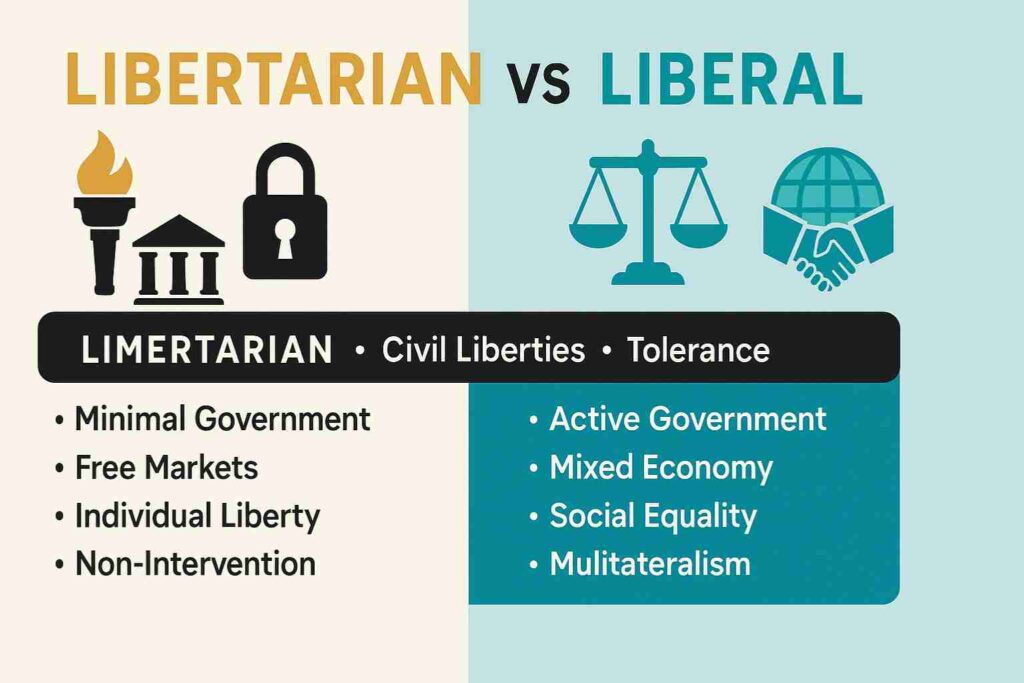
Quick Definitions
Liberal (modern US usage): Supports civil liberties, social equality, and a mixed economy where government plays an active role to fix market failures and expand opportunity (e.g., anti-monopoly rules, labor rights, safety nets).
Libertarian: Centers almost entirely on individual liberty and voluntary exchange. Government should be minimal—mainly to protect people from force and fraud; extensive regulation and redistribution are viewed as rights-violating.
Think of it this way: Liberals ask, “How can policy expand real freedom and equality?” Libertarians ask, “How can we maximize freedom by limiting state power?”
Shared Roots, Divergent Paths
Both traditions trace back to classical liberalism (Locke, Mill): individual rights, consent of the governed, private property. Over the 20th century, modern liberalism embraced a stronger state to secure equal opportunity and social justice, while libertarianism doubled down on minimal government and robust property rights.
Side-by-Side: What Each Believes
Role of Government
Liberal: Government should protect and promote rights and opportunity (e.g., civil rights acts, anti-discrimination, public education).
Libertarian: Government should only protect rights (life, liberty, property); most other functions should be private or local/voluntary.
Economy & Taxes
Liberal: Mixed economy; accepts regulation to curb market failures, progressive taxation to fund public goods and safety nets.
Libertarian: Laissez-faire; opposes most regulation and redistribution; emphasizes free markets and strong property rights.
Social Issues
Liberal: Uses government to advance equal protection (e.g., voting rights, anti-discrimination, reproductive rights). Wikipedia
Libertarian: Government should not police private, consensual behavior; civil liberties are central, but without state-led equality programs. Libertarian Party
Foreign Policy
Liberal: More supportive of multilateral institutions and humanitarian involvement, with debate over scope.
Libertarian: Generally non-interventionist; end “forever wars,” close overseas bases, and prefer diplomacy and trade over military action.
Where They Overlap (Yes, There’s Common Ground)
Civil liberties: Free speech, privacy, due process—both care (often for different reasons).
Criminal justice reform: Opposition to mass surveillance, civil asset forfeiture, and over-criminalization is common.
Social tolerance: Many libertarians and liberals support LGBTQ rights and keeping government out of personal choices.
Where They Clash (The Big Three)
Redistribution:
Liberal: progressive taxation to fund healthcare, education, and anti-poverty programs.
Libertarian: redistribution violates property rights; prefer voluntary charity and markets.
Regulation:
Liberal: guardrails to protect consumers, workers, and the environment.
Libertarian: regulations often backfire, create barriers to entry, or enable cronyism.
Scale of the State:
Liberal: active state to achieve substantive freedom (not just formal rights).
Libertarian: small state to preserve negative liberty (freedom from coercion). Stanford Encyclopedia of Philosophy
A (Very) Short History & Parties
Libertarian Party (US) founded in 1971; emphasizes maximal liberty in economics and personal life. In 1980, nominee Ed Clark reached roughly 1% nationally; the party remains the leading third party by organization. study.com
In 2024, Libertarians nominated Chase Oliver for president, highlighting non-interventionism and civil-liberties themes.
Modern liberalism in the US took shape through reforms such as the New Deal and Great Society, pairing civil liberties with a welfare-state, mixed-economy model.
Policy Snapshots (with Real-World Examples)
Healthcare
Liberal: Treat healthcare as a right; support public options or single-payer to expand coverage.
Libertarian: Oppose mandates and most subsidies; favor deregulation, transparent pricing, HSAs, and competitive markets.
Education
Liberal: Public funding, equity programs, and accountability standards.
Libertarian: School choice and privatization; limit federal role.
Guns
Liberal: More regulation (background checks, red-flag laws).
Libertarian: Protect gun rights; punish misuse rather than ownership.
Drugs & Personal Autonomy
Liberal: Decriminalization paired with public-health investments.
Libertarian: Legalize/fully decriminalize; focus on consent and harm.
Foreign Policy
Liberal: UN, alliances, conditional interventions.
Libertarian: Non-intervention; close many overseas bases; prioritize diplomacy. AP News
Spectrum & Variations (It’s Not Binary)
Left-libertarians accept stronger egalitarian norms about natural resources while keeping a minimal state.
Classical liberals sit between modern liberals and libertarians: strong markets, but more room for limited public goods.
How to Tell Them Apart in One Minute
Ask: Should government actively promote equality and opportunity?
If yes, you’re hearing a liberal view.
If no—just protect rights, you’re hearing a libertarian view.
Glossary (fast, credible definitions)
Negative liberty: Freedom from interference; libertarians prioritize it.
Positive liberty: Capacity to act meaningfully; liberals emphasize enabling conditions (education, healthcare).
Mixed economy: Markets plus regulation/safety nets—modern liberal hallmark.
Conclusion
“Libertarian vs liberal” isn’t a word game; it’s a clash of means—minimal state vs active state—for protecting freedom. Liberals argue that smart policy expands real-world liberty and equality; libertarians argue that limiting the state best preserves freedom. Now you can spot which is which—and debate the substance, not the labels.
FAQs
1) Are libertarians always right-wing?
Not necessarily. Many are right-leaning on economics but socially liberal on personal freedom, and some identify as left-libertarian on resource equality—still with a minimal state.
2) Do liberals oppose markets?
No. Modern liberalism backs markets with rules to prevent monopolies and protect workers/consumers—a mixed economy, not state socialism.
3) Why do libertarians resist taxation?
They see strong property rights as core to liberty; taxes for redistribution are viewed as coercive beyond rights-protection.
4) Where do both sides agree most?
Civil liberties and keeping government out of private, consensual behavior—though liberals more readily support anti-discrimination law.
5) Who represents these views in US politics today?
The Libertarian Party explicitly campaigns on minimal government; liberal positions are common in the Democratic Party’s policy agenda (civil rights plus a mixed economy).